
Here at ISTA, we research many things that are so small that they can only be seen with high-tech microscopes. The Imaging and Optics Facility (IOF) provides the Researchers with over 50 different Machines, trains them on how to proficiently use them, and even supports them with experimental design and the evaluation of results. While the microscopy images can tell us a lot about the smallest parts of nature such as cells, bacteria and even single proteins, they also often produce beautiful works of art. Therefore, once a year we hold our “scientific image competition”, so we can present these beautiful images and let the visitors of the annual Open Campus Day vote the most beautiful one.
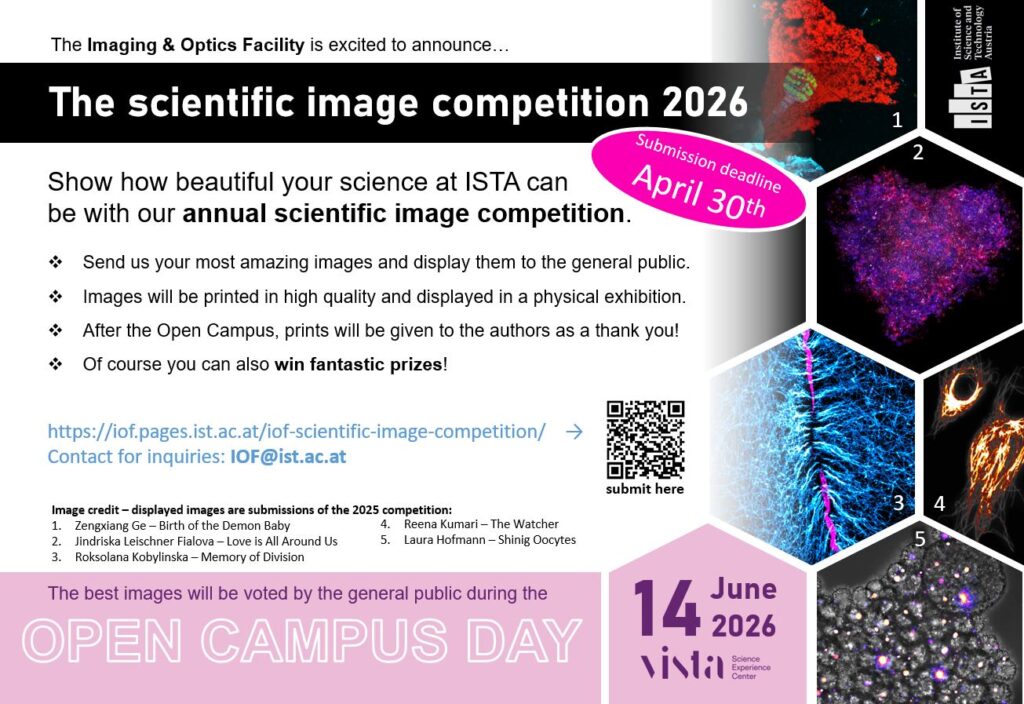
We are happy to announce the 2026 scientific image competition
Submit your image HERE!
Submission Deadline: 30th April 2026
The image competition is currently not open for submissions.
We will inform you timely about the next competition.
*the submission page is only available from within the ISTA network
For any questions, contact us at IOF@ist.ac.at
Past competitions and submissions
(click on the images to enlarge)
Our image analysis team put some effort into analyzing the results.
Find the voting analysis and results in this amazing git repository.
Winners of the 2026 competition:
1st place (68 votes): The Dragon’s Gaze Beneath the Lens by Dmitrii Vladimirtsev

What seems like the watchful eye of a hidden dragon emerges from living plant tissue. Glowing emerald membranes trace intricate cellular borders, while flickering crimson signals pulse like embers – revealing a dynamic, unseen world that feels almost alive with intent.
Imaged on Leica SP8 inv
2nd place (50 votes): Becoming Two by Michaela Jovic and Carl-Philipp Heisenberg

Shown is a single-cell ascidian embryo captured at the moment of its very first division: the beginning of everything. Green microtubules radiate from two poles, pulling on the yellow actin cortex at the cell surface while pushing against each other at the midline. This fine mechanical balance will result in one becoming two.
Imaged on Leica Stellaris5
3rd place (44 votes): Cellular Island by Prajwal Patil

Cells facing extreme environmental conditions respond in different ways. The cells of the zebrafish embryo cannot handle the hypotonic stress, and the cells fail to divide properly. The outer membrane stops the division, but the nucleus does not receive the memo. After a few rounds of divisions, we get an island of cells on top of a sea of nuclei.
Imaged on Nikon CSU-W1-02
Other Submissions (in no particular order):
Methinks I have Astronomy by Kristen Léonard

A semiconductor chip was lost in hydrofluoric acid, and later retrieved. The resulting damage left the chip unusable, but with a fascinating pattern reminiscent of perhaps outer space or the deep sea with curious eye or neuron shaped structures.
A Wound That Lights Up by Nada Kassem and Jiri Friml

This image captures the moment a plant leaf begins to heal after its stalk is cut. The bright signal shows where auxin‑dependent nuclear activity switches on, revealing the first cells that respond to injury and start the regeneration process.
Imaged on Zeiss LSM-02_800inv
Immune Highways and the Cells That Answer Their Whisper by Zane Alsberga

Here, we can see lymphatic vessels in the skin tissue of a mouse ear. The lymphatic vessels act as highways for immune cells to travel across tissues to wherever they are needed most. In some of the images, we can see dentritic cells (green and magenta), important guardians that scout our tissues for anything out of the ordinary, that have been recruited to a site of local inflammation.
Imaged on Zeiss LSM-02_800inv
Creating Dimension by Michaela Jovic and Carl-Philipp Heisenberg

Shown is ascidian embryo halfway through division, viewed from the cell surface. The bright orange signal shows actin accumulating where the cleavage furrow pinches inward: a contractile ring tightening around the embryo’s midline, directly between the two newly forming cells. This drawstring-like ring bends the surface inward, sculpting radial symmetry into three-dimensional form.
Imaged on Leica Stellaris5
The Creation of a Signal by Eleonora Quiroli

This image shows two neurons of the mouse retina (retinal ganglion cells) with their dendritic arbors extending across the tissue. Their near-contact and opposing arrangement evoke The Creation of Adam by Michelangelo, suggesting a moment of connection and the emergence of neural signaling.
Imaged on Nikon CSU-W1-02
Starry Night by Ana Villalba Requena

This image captures a small region of a mouse brain, where individual **neurons**glow like stars in a night sky. Using a genetic technique called **MADM**, each neuron is uniquely labeled, allowing scientists to trace its shape and connections. These cells form intricate networks that underlie how the brain develops and functions, revealing the hidden beauty and complexity of neural circuits.
Imaged on Nikon CSU-W1-02
Mesh of Life by Lia Heinemann Yerushalmi and Roksolana Kobylinska

This image shows the outer layer of a single cell in a zebrafish embryo shortly after fertilization.
In green, you see actin—tiny fibers that form the cell’s internal structure, like a building’s framework.
In magenta, you see GAPDH, a protein that helps the cell break down sugar to produce energy.
For the first time, this image captures both actin and GAPDH together in a living, developing embryo, revealing how cell structure and metabolism may be closely connected.
Imaged on Zeiss LSM-08_880inv
New Embryo´s Fireworks by Vojtěch Šabata and Long Li

Cell division in the early zebrafish embryo. Microtubule filaments (in yellow) are both extending radially to the boundaries between cells and segregating DNA (in blue) into the forming daughter cells.
Imaged on Zeiss LSM-02_800inv
Chaotic Inferno by Wiktoria Czumaj and Himani Khurana

Understanding intracellular signalling is imperative to battle bacterial infections. Proteins, MavQ and SidP, depicted in the image, are produced by *Legionella pneumophila*bacterium upon human infection. *Legionella* are intracellular pathogens, which strive to disable the host’s innate immune response. To achieve this, they developed a strategy, which involves producing unique bacterial effectors, such as MavQ and SidP, to alter the membrane identity and avoid degradation. Their dynamic behaviour, observed with advanced microscopic techniques, can help us understand how they coordinate their activity. By studying these proteins on simplified models *in vitro* and investigating them in high temporal and spatial resolution, we are one step closer to deciphering how the infection develops and how to stop it.
Imaged on Nikon iLAS TIRF
Sisterhood by Anna Pellizzer

What you’re looking at is the natural glow of C. elegans, tiny 1‑millimetre hermaphrodite worms that light up when illuminated with blue light. Scientists usually find this autofluorescence a bit annoying… but every now and then, it surprises us with moments of unexpected beauty. Here, three radiant sisters are hanging out together, plus one who’s fashionably late — still an embryo in her egg, but already glowing like she knows she belongs.
Imaged on Andor Dragonfly 505
Hotspots of RNA Processing by Shubhajit Das, Lukas Fiedler and Jiri Friml

You are looking at a very young gemma of *Marchantia polymorpha*, one of the earliest land plants to emerge during evolution. The bright fluorescent spots represent the cell nuclei, where a protein involved in RNA processing has been fused to a fluorescent reporter for visualization.
Imaged on Leica Stellaris5
Breaking Symmetry by Andreea Corina Luca

Cells in the developing neural tube normally grow in a highly organized, symmetrical manner. Here, this balance is disrupted, causing cells to be pushed out of the tissue.
Imaged on Zeiss LSM-01_900inv
Painting the Roses Pink by Vittoria Mariano

Pink flowers? Almost.
These pink structures are called “rosettes” because they look a bit like little flowers. They are typically found inside a brain organoid, also called a “mini-brain.” Brain organoids are tiny 3D models grown in the lab from human cells. Scientists use them to study how the human brain develops and grows.
In this image, magenta highlights the rosette structures, made of young cells that can become neurons. Yellow shows cells that are actively multiplying in the center of the rosettes. Blue marks the nuclei, the central part of each cell, throughout the organoid.
Imaged on Zeiss LSM-01_900inv
Don’t Hurt me or I Will Turn Blue! by Nada Kassem, Jiri Friml

These two leaves show how plants sense injury and begin to heal. The leaf on the left is untouched (not hurt), while the one on the right has had its petiole cut. After the cut, the plant sends a surge of auxin — a hormone that guides growth and healing — to the wound and along the veins. The deep blue color comes from a reporter that turns blue wherever this healing signal becomes active, revealing the exact spot where the plant is preparing to grow a new root.
A Thorny Issue by Jake Watson

Here we see two brain cells from a human patient who had surgery to treat epilepsy. We recorded the properties of these neurons to better understand how human brain circuits function. Across their tree-like branches, we can see ‘thorny excrescences’ – the complex structures where these cells receive input from other neurons. Understanding how human neurons connect and communicate may help us to better understand how our own brain works.
Imaged on Andor Dragonfly 505
The Secret Universe of Plants by Dmitrii Vladimirtsev

Beneath the surface of an ordinary leaf lies an extraordinary world. With the help of fluorescent light, the hidden architecture and movement inside living plant cells become visible, transforming biology into a landscape of light and constellations.
Imaged on Zeiss LSM-05_800vert
The Flyer:
Winners of the 2025 competition:
1st place: Equilibrium: The Moment Before the Split by Michaela Jovic

This one-cell ascidian embryo is caught mid-mitosis, moments before its very first division. The mitotic spindle (magenta-yellow) stretches across the cell’s midline, holding the chromosomes (green) in perfect alignment at the metaphase plate; all suspended in the glowing cytoplasm (cyan). Life is about to multiply – by dividing.
2nd place: Neural Bloom by Eleonora Quiroli

This image shows a mouse retina. Mice are primarily nocturnal animals and, unlike humans, they possess the ability to detect ultraviolet (UV) light due to the presence of UV-sensitive pigments in their photoreceptors. In this image, you can see the UV-sensitive pigments colored in cyan.
Once the light is detected and processed, information needs to be transmitted to the brain through a projecting neuronal family called the ganglion cells (GCs). In magenta, you can see highlighted some GCs, which converge their projection to the center of the retina, creating the optic nerve – the wire that will connect the retina to the brain.
While the retina is naturally shaped like a hemisphere, during experiments it is dissected and flattened into a flower-like shape for imaging. This layout allows for a comprehensive view of the retinal structure and cell distribution.
3rd place: Untangling the Brain, One Neuron at a Time by Jake Watson


Here, the blue star-like map shows all the neurons in a small piece of brain tissue. We record the properties of a few of these neurons (in red), which also reveals their full, intricate shapes. This images shows neurons recorded in the Cerebellum of a mouse brain tissue tissue, demonstrating both the beauty and complexity of the brain.
Other Submissions (in no particular order):
Flourescent Heart of ISTA by Manuel Alonso Y Adell Martin W Hetzer, Doreen Milius

This image shows nuclear pores – tiny gateways on the surface of the cell nucleus, marked in glowing colors. The green dots represent older pores, while the red dots show newly made ones. By switching the color over time, we can track how these essential structures change and renew inside ageing human cells.
On the Move by Ingrid de Vries

These are dendritic cells (immune cells) migrating in the direction of a chemoattractant, in a 2D environment.
We created this 2D environment by placing the cells under a block of agarose. Here the cells, which are normally round with many dendrites (“folds” or “arms” in the cell surface), become very flat. This makes it simpler to study, what happens in the cells during migration. We are seeing the microtubules (black), the nucleus (blue) and the actin structure and dynamics (green).
Smile of Neurons by Vittoria Mariano, Peter Koppensteiner and Gaia Novarino

This image shows human cortical neurons grown in transplanted cerebral organoids. Cerebral organoids are 3D culture systems derived from human pluripotent stem cells that mimic key features of human brain development. To support the growth and maturation of these neurons, the cerebral organoids can be transplanted into the brain of a rat. In this environment, the human neurons continue to develop into mature, functional neurons. These models provide a powerful tool for scientists to study human brain development and to better understand how neurons grow, connect, and function.
Maternal Embrace by Zengxiang Ge

In this image, we can see a tiny new plant beginning to grow inside an ovule — a small structure within the mother plant where seeds start their life.
Birth of the Demon Baby by Zengxiang Ge

In seed plants, the embryo emerges from the ovule — where maternal tissues once protected and nourished it. In this image, the embryo was gently squeezed out from its ovule, showing a flame-like form that evokes the raw power of new life.
Embryo as Canvas by Xin Tong, Yann Cesbron, Carl-Philipp Heisenberg

This image shows the cellular surface of an early zebrafish embryo. In order to study the behavior of tissues under damage and stress, we can use strong lasers to make tiny precise incisions on the cellular level. Here, I created the name of our lab and “ISTA” onto this cellular surface. In the **accompanying movie**, you can appreciate the dynamic process how the “sculpture” was created.
Competition of Fluorescent Bacteria by Roderich Römhild Calin C. Guet

Mixtures of two bacteria are spreading on a black plate, each as fast as it can. To tell them apart the bacteria are labelled with proteins that reflect light with yellow or blue fluorescence. Compare the amounts of yellow and blue in each spot to find the winner!
Prismatic Dreams of the Neural Cosmos by Yuwei Chen, Maximilian Schuster and Bernhard Hochreiter

This image shows a brain slice from a 21-day-old transgenic mouse, with single neurons and glial cells labeled in a sparse and distinct pattern. The labeling was achieved using Mosaic Analysis with Double Markers (MADM), a genetic technique that highlights individual cells with unique fluorescent markers. This approach allows scientists to study cell lineage, gene function, and cell interactions in a detailed manner. In this mouse, MADM reporter cassettes were integrated in a way to label all cells derived from progenitors in the cortex and hippocampus.
The Maze of the Worm’s Neurons by Anna Pellizzer Niko-Amin Wetzel, Hanna Schön

This image shows a *C.elegans* worm, a tiny 1 mm organism widely used in biological research, including neuroscience. The glowing branches you see are the extensions of two key neurons that allow the animal to sense touch. Despite being only a worm, *C. elegans* has helped researchers uncover fundamental biological mechanisms, and in the de Bono lab, it is used daily to better understand how neurons function.
Marchantia Polymorpha Sperm by Xiaoqi Feng, Drishtant Chakraborty, Weizhi Ouyang, Victor-Valentin Hodirnau


While most land plants have evolved to reproduce without relying on water, the liverwort *Marchantia polymorpha* still uses motile sperm that swim through water to reach and fertilize nearby female plants. This cryo-electron tomography image shows a *Marchantia* sperm cell, highlighting its long flagella and condensed nucleus—features that allow the sperm cell to swim rapidly through water.
Lighting Up the Rhizosphere: RFP-Pseudomonas on Arabidopsis Roots by Iva Atanasković & Dekel Cohen Hoch, Eva Benkova, Calin Guet

This image shows a natural root-dwelling bacterium, *Pseudomonas thivervalensis* OR228, labeled with a red fluorescent protein (RFP), as it colonizes the root surface of a young *Arabidopsis thaliana* seedling. The glowing red bacteria highlight the intimate relationship between plants and their microbial partners, revealing how tiny microbes live and interact with plant roots in the soil.
Cyanobaklava by Benjamin Springstein

In this image you can see cyanobacteria, which have inhabited earth for more than 3.5 billion years, counting among the oldest organisms on earth. Long before plants existed, they performed photosynthesis, saturating the early atmosphere of Earth with Oxygen and making the development of more complex lifeforms possible. In the image, the Actin homolog (ParM) filaments are stained, which cover the inner membrane like a skeleton, keeping the cells intact.
Confined Filament Webbing by Roman Hajdu

In this image, you can see a network of filaments that self-assembles on a rectangular patterned artificial membrane. Different filaments are important for many processes within living cells: structural as a form of skeleton, as active means to change shape and move, and even as a connected transport network for proteins within the cell. The top shows a single snapshot of the network, and the bottom image projects it’s change over time. The assembly of this network can be seen in the **accompanying video**.
Cell Arches by Philippe Dehio

Immune cells patrol our tissues, searching for and destroying invaders like bacteria and viruses to protect us from infection. Their movement is powered by an internal framework called the cytoskeleton—a dynamic network of proteins. In this image, the cytoskeleton is revealed using a fluorescent probe, highlighting the elegant structures that drive these microscopic defenders.
Neuronal Horizon by Ivan Krylov

Expansion microscopy is a special technique in which the tissue is “blown-up” in a hydrogel in order to increase the size manyfold and thereby make it easier to visualize tiny structures within the cells. In this image, you can see an expanded brain tissue that fades into darkness at the edge of the hydrogel.
Highway to Integration by Ana Villalba Requena

The image shows part of a mouse brain. At the center, a “road” for neuronal projections can be seen – the corpus callosum – which plays a key role integrating the information between both brain hemispheres. Neurons are labeled (in green, red and yellow) using a genetic tool called MADM, that allow us the visualization of single cells and their detailed morphology to study potential alterations caused by genetic mutations.
99 Neuro-Balloons by Ana Villalba Requena

A snapshot of 99 (give or take) neural progenitor cells — the apical radial glia cells — which generate the vast majority of cells in the cerebral cortex. These cells remain attached to the apical surface in a “balloon shape” while dividing to produce neurons during brain development. Apical radial glia cells are labeled using a genetic tool called MADM, which allows visualization of individual progenitors and all their progeny. The blue signal of the background belongs to the nuclei of other non-labeled cells.
Memory of Division by Roksolana Kobylinska

This image shows two newly formed cells immediately after division in a zebrafish embryo within the first hours after fertilization. The magenta and cyan fluorescence reveal elements of the cytoskeleton – the dynamic internal scaffold that maintains the shape and organization of the cell. Actin, shown in magenta, defines the newly formed boundary between the daughter cells, while cyan microtubules remain partially continuous across the two. Though division is complete, the intertwined microtubule network preserves a fleeting trace of their recent unity.
Shining Oocytes by Laura Hofmann

In this image, you can see Zebrafish oocytes with a fluorescent marker showing a protein in the Balbiani body (buc), an organelle necessary for embryonic axis and germ cell formation in the embryo.
The Watcher by Reena Kumari

A striking example of pareidolia in cell biology, this image captures the microtubule network within a migrating immune cell, unexpectedly resembling the form of an owl in flight. Microtubules, the dynamic filaments that guide intracellular transport and cell polarity, here assemble into a structure that evokes watchfulness and motion. Like a nocturnal sentinel, the cell seems to peer outward, its cytoskeletal architecture glowing with purpose. This image invites us to see the hidden poetry in biological form—where structure meets symbolism under the microscope.
Love is All Around Us by Jindriska Leischner Fialova

In this image, you can see mouse embryonic stem cells differentiating into neural tube cells. These cells have an active BMP signaling pathway (red cells). Moreover, you can notice an onset of the formation of neural rosettes with primary cilia (white structures) oriented towards the center of each rosette. Typically, we grow these colonies in a circular shape, but occasionally we observe irregular formations – as seen here, where the cells have formed almost a perfect heart-shaped colony.
The Inner Cosmos by Reena Kumari, Isabelle Mayer, Michael Sixt

What lies within a cell? A vibrant, structured universe. This microscopy image shows actin filaments—tiny fibers that form the cytoskeleton—rendered in colors based on their depth inside the cell. The result is a breathtaking glimpse into the cellular architecture that shapes life, mirroring the vastness and elegance of the cosmos itself.
March of the Guardians by Reena Kumari, Michael Sixt

Like a field of windblown grass or ocean currents frozen in time, this image shows immune cells on the move. Their internal highways—microtubules—guide their migration, helping them patrol and protect the body. Captured in stunning grayscale, the texture reveals the elegant choreography of life at the microscopic scale: quiet, precise, and full of purpose.
The Cellular Bloom 🌸 by Reena Kumari, Michael Sixt

What looks like a cosmic garden is actually a group of immune cells—macrophages—glowing under the microscope. Their actin filaments stretch outward like petals in bloom, helping them explore and protect. Science meets beauty at the cellular level.
The Crawlers Within by Reena Kumari, Michael Sixt

At first glance, they appear alien—tentacled, glowing, drifting in darkness. But these are no deep-sea creatures or cosmic life forms. These are macrophages, immune cells that live within us.
Their glowing extensions are actin filaments, structures that help the cell move, reach, and respond. In this image, they resemble strange animals—part jellyfish, part insect, part something else entirely—beautiful and haunting. Each shape tells a story of vigilance: scanning, sensing, protecting.
Seen through the lens of art and science, these cellular guardians remind us that the most mysterious life forms might be the ones already inside us.
Little Tongue by Mohammad Goudarzi, Lena Schwarz

On this image, we see a mouse embryo’s head in the early stages of development. Images are taken at many different depths and projected into a reconstructed image to make the entire head clearly visible. Techniques like this allow us to investigate the embryonal development from single cell up to the fully grown animal.
The Flyer
